A note of gratitude from the President and First Lady.
Thank You letter from the White House "Black Klansman"
Testimonials
I encouraged Ron Stallworth to write this book. It is a brilliant demonstration of police intelligence thinking outside the box. More than this, it is a revealing story exposing the utter stupidity of racial prejudice among the most notorious and supposedly intelligent people. A special gem awaiting the reader who searches a little deeper are moments of subtle covert bias hidden even in our own law enforcement circles. I must admit, I enjoyed the amusing way these arrogant fools are publicly stripped of their facades.
--Richard Valdemar (Retired Sergeant Los Angeles County Sheriff’s Department)
“Ron Stallworth infiltrated the ruthless Ku Klux Klan, as an African-American police detective. With courage and brilliance he breached this oldest and violent white supremacist hate group. Although Ron encountered internal political dissentions that would jeopardize his career, he had the fortitude to keep going; quitting was not an option! There are many training manuals on “how to work undercover.” Most give you the basics, but fail to expand on this dedication, commitment, and the personal and political sacrifices to succeed. Ron Stallworth tackles these struggles in his book of an untold written chapter in the history of the Colorado Springs Police Department.”
--Robert C. Cantwell Retired Director, Colorado Attorney-General Organized Crime Strike Force “
Monday, June 23, 2014
Ignorant KKK video "Leaked"Inside a Black Man's Mind
Sergeant Ron Stallworth, (Ret.) is a 32-year law enforcement veteran who began his career in 1972 at the age of 19 with the Colorado Springs Police Department (CSPD). In 1975 he became the first Black detective in the history of the CSPD as well as the youngest at the age of 22. He worked undercover narcotics, vice, criminal intelligence and organized crime. During this time, he initiated the investigations which are the subject of this book. He later served a one-year assignment as an investigator with the Colorado Attorney General’s Organized Crime Strike Force. He left the CSPD in 1980.
From 1980-82, Sergeant Stallworth worked narcotics and organized crime intelligence in Phoenix, Arizona for the Arizona Drug Control District (later known as the Arizona Criminal Intelligence Systems Agency). From 1982-86, Stallworth worked undercover narcotics as a Special Agent for the Wyoming Attorney General’s Division of Criminal Investigation.
In 1986, Sergeant Stallworth was hired as a Special Agent by the Utah Department of Public Safety’s Narcotics & Liquor Law Enforcement Bureau, later known as the Utah Division of Investigation. In 1989, he researched and authored the report that led to the creation of the Gang Narcotics Intelligence Unit, a joint effort between the Utah DPS and Salt Lake City Police Department. With the aid of federal grant money, that unit later evolved into the Salt Lake Area Gang Project now known as the Metro Gang Unit, the first multi-jurisdictional gang suppression and diversion unit in the state. From the recommendations contained in Sergeant Stallworth’s report, several other gang task forces later became operational in the state. The Utah Public Safety Commissioner later named Sergeant Stallworth the state’s Gang Intelligence Coordinator. He was the first, and to date, only person to hold this position.
While working gangs, Sergeant Stallworth began researching the correlation between gangster rap music and street gang culture. He subsequently wrote four books on the subject (two of which have been published) and has authored numerous articles for magazines and journals. In the 1990’s, Sergeant Stallworth testified at three congressional hearings on the subject of gangster rap music, gangs, and youth violence in America. In 1998, the National Gang Crime Research Center honored him with its prestigious “Frederick Milton Thrasher Outstanding National Leadership Lifetime Achievement Award.” Sergeant Stallworth was a consultant for the 2009 Gangland episode, “From Heaven to Hell,” about the Polynesian Tongan Crip Gang of Salt Lake City.
Sergeant Stallworth holds a BA in Criminal Justice Administration from Columbia College (Salt Lake Campus). He has been a guest lecturer at the University of Utah, Brigham Young University, University of Texas - El Paso, Utah State University, Weber State University, San Francisco State University, Westminster College (Salt Lake City), and Columbia College (Salt Lake City and Missouri campuses). Sergeant Stallworth was an Adjunct Criminal Justice Instructor at Salt Lake Community College from 2008-2013. Ron was awarded a letter of commendation from the Colorado Attorney General during his year with the Organized Crime Strike Force. He retired from the Utah Department of Public Safety in 2005 after a 20-year career during which he was a two-time recipient of the department’s Distinguished Service Award.
Former El Pasoan Ron Stallworth still carries an official
Ku Klux Klan membership card in his wallet.
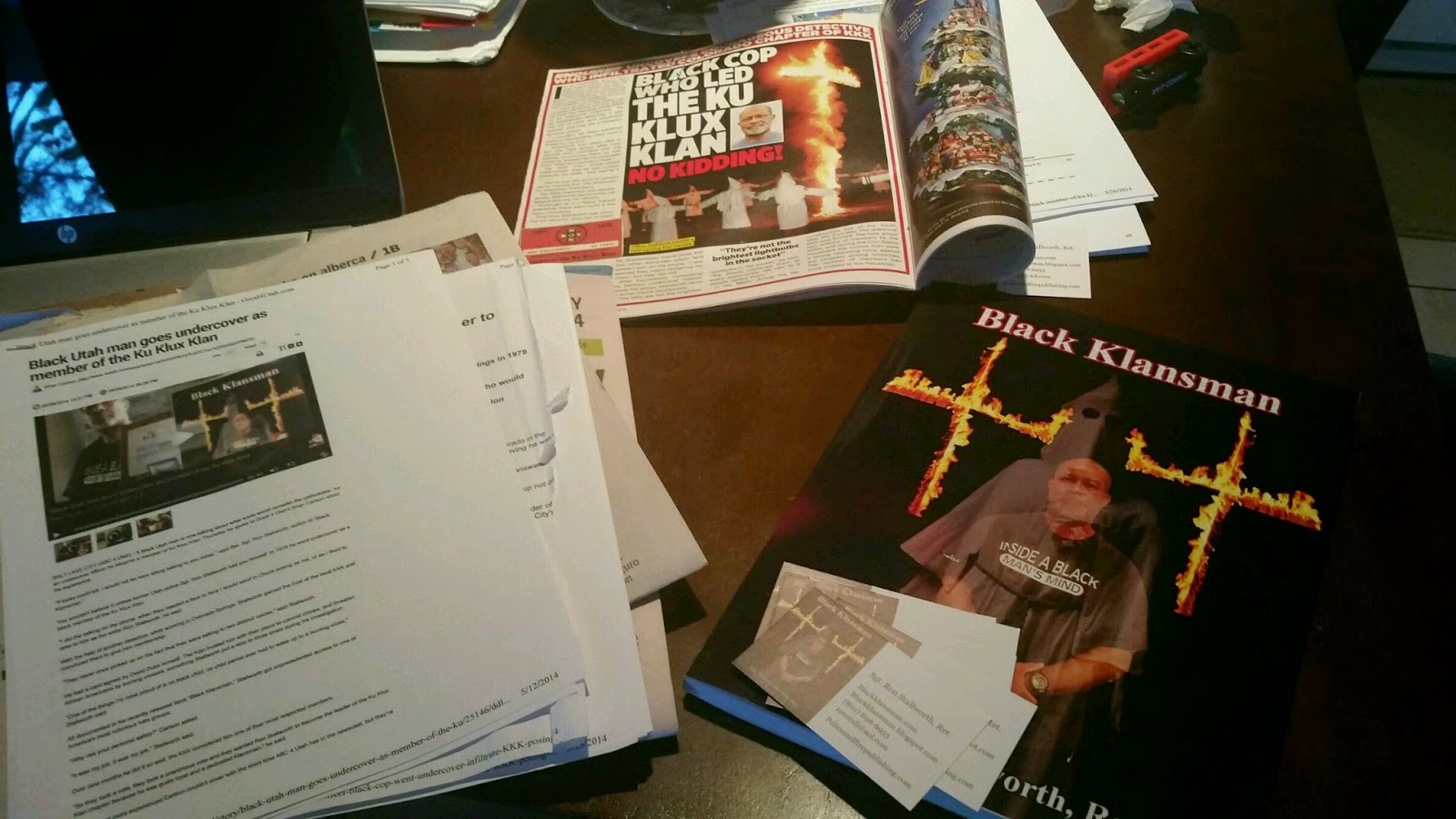
Stallworth details how he infiltrated the Ku Klux Klan in "Black Klansman," a new book describing his work as an undercover intelligence
police officer in Colorado Springs, Colo.
Stallworth, 60, a 1971 graduate of Austin High School, became the
youngest and first black detective in the Colorado Springs Police Department, 22 months after he signed up as a patrolman.
"I broke racial grounds in that department," he said during a recent visit to El Paso.
Stallworth, a decorated
police officer, retired in 2005 after 32 years working undercover
investigating narcotics, vice, criminal intelligence and organized crime
in Colorado, Arizona and Utah.
Stallworth monitored subversive groups or individuals while working as an intelligence officer in Colorado in 1978.
One day, he spotted a newspaper classified ad posted by the local Ku Klux Klan chapter as part of its recruiting efforts.
Stallworth sent a note to a post office box saying that he was a
white racist interested in learning more about the Klan. He mistakenly
signed his own name and included an undercover telephone number.
"I thought they'd send me a leaflet or something like that," he said.
"Six days later, I get a phone call on the undercover phone line. The
guy identified himself as the local leader of the new Ku Klux Klan
chapter in Colorado Springs. He wanted to know why I wanted to become a
Klansman. Thus began my journey into becoming a black Klansman."
The two agreed to meet a week later, but "for obvious reasons, I couldn't meet with him," Stallworth said.
So Stallworth recruited a
friend in the narcotics division to pose as him during face-to-face
meetings with the Klan leaders. He continued to chat with the Klan
leadership by phone.
"These idiots never figured out that they were talking to two different people," he said. The book also describes Stallworth's relationship with David Duke, a
former Grand Wizard of the Ku Klux Klan. At one point, Stallworth was
assigned to help provide security for Duke during a visit to Colorado.
Stallworth had other brushes with history. He once was assigned to
undercover work monitoring Stokely Carmichael, a charismatic black
activist in the civil rights movement.
He also has written and published books on the correlation between gangster rap music and street gang culture.
About his 32 years service in law enforcement, Stallworth said he
always wanted to become an undercover police officer, partly because he
hated wearing uniforms.
"I'm somewhat radical," he said. "I have very little decorum. If I want something I go get it."
Black History Month, also known as African-American History Month in America, is an annual observance in the United States, Canada, and the United Kingdom for remembrance of important people and events in the history of the African diaspora. It is celebrated annually in the United States[1] and Canada[2] in February and the United Kingdom[3] in October.