Showing posts with label Black Klansman. Show all posts

Tuesday, June 2, 2015

Top officials and police officers quit after a black woman was elected mayor for the first time.


Courtesy of Neal Colgrass

Shhh: You might hear a pin drop in the city hall of Parma, Missouri, where top officials and police officers quit after a black woman was elected mayor for the first time, KFVS reports via the Huffington Post. Former city clerk Tyrus Byrd was sworn in as mayor last week, after beating 37-year incumbent Randall Ramsey by a 38 votes, 122-84. But Byrd is without a clerk, city attorney, or water treatment supervisor, who promptly walked off the job; five of Parma's six cops did as well, claiming "safety concerns." Byrd has no comment on the walkouts, but says she hasn't been able to find resignation letters reportedly left behind, the Daily News reports.

On the bright side, Byrd says she's getting assistance from residents and other communities to help keep the town on track, WSMV reports. And Parma residents are weighing in: "I think it's pretty dirty they all quit without giving her a chance," says Martha Miller, a white resident. "But I don't think they hurt the town any by quitting, because who needs six police for 740 people." Black resident Terrell Thatch sees it a little differently: "They say we have six cops on the payroll," he says. "How can we have six cops, and go days without cops patrolling? You know, and we've got these recent break-ins." According to Wikipedia, the 2010 census found Parma to be about 67% white, 29% black, and 2.8% Latino. (See how officials in Ferguson, Missouri joked about black abortions.

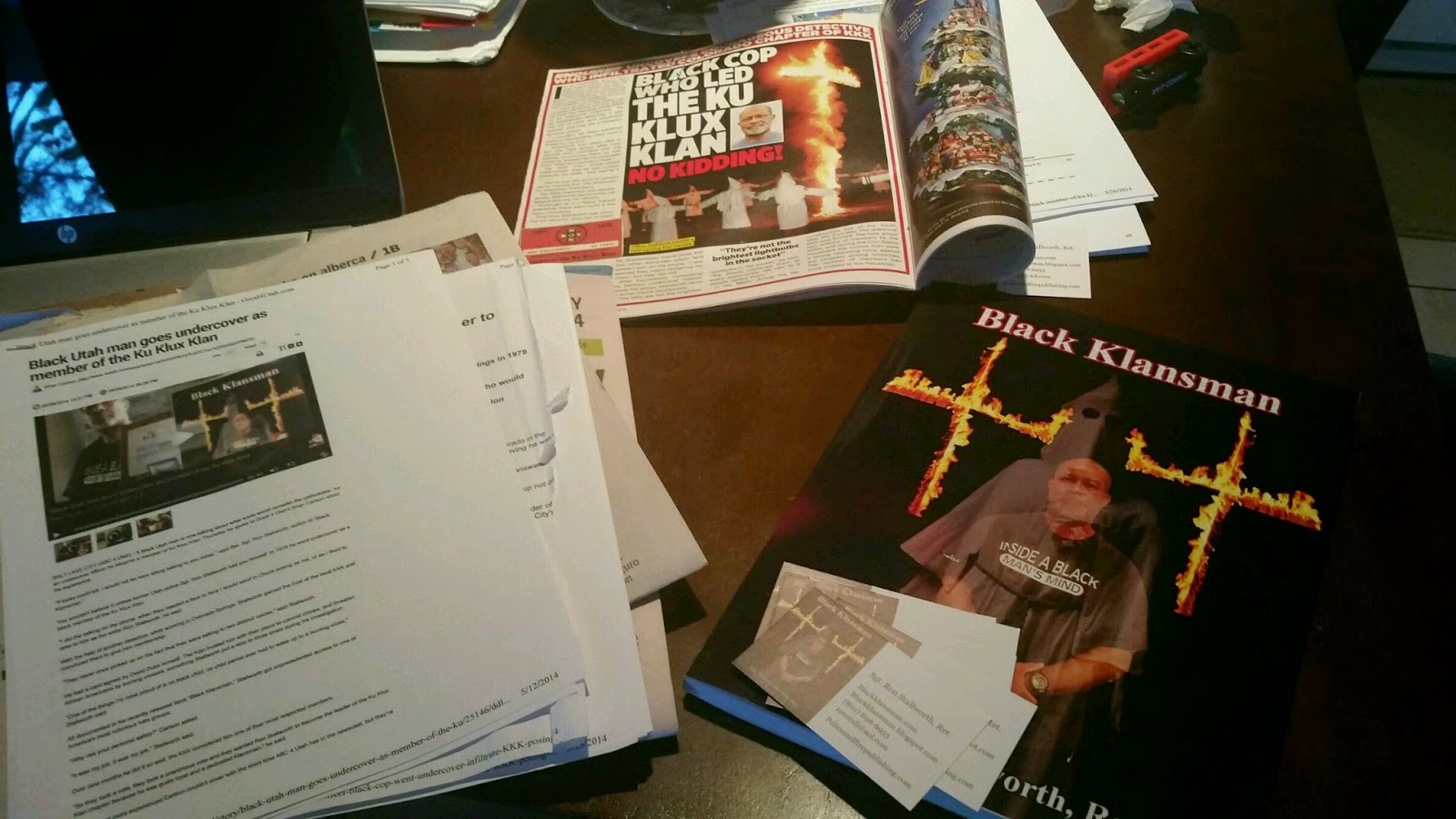
How does a Black police officer working undercover in Colorado Springs become a card carrying member of the Ku Klux Klan? And do it so convincingly that he is asked to lead the local KKK chapter? Ron Stallworth's new book tells a story that would be fascinating as fiction but is made all the more exciting because it is true. Black Klansman is a worthwhile and important read. I enjoyed it immensely and recommend it highly.

Laura Minor

Manager, Bauman Rare Books

Las Vegas, Nevada

Robert Vaughan 

Friday, September 26, 2014

Thank you Mr. President

A note of gratitude from the President and First Lady.


Thank You letter from the White House "Black Klansman"

Testimonials


I encouraged Ron Stallworth to write this book. It is a brilliant demonstration of police intelligence thinking outside the box. More than this, it is a revealing story exposing the utter stupidity of racial prejudice among the most notorious and supposedly intelligent people. A special gem awaiting the reader who searches a little deeper are moments of subtle covert bias hidden even in our own law enforcement circles. I must admit, I enjoyed the amusing way these arrogant fools are publicly stripped of their facades.

--Richard Valdemar (Retired Sergeant Los Angeles County Sheriff’s Department)

“Ron Stallworth infiltrated the ruthless Ku Klux Klan, as an African-American police detective. With courage and brilliance he breached this oldest and violent white supremacist hate group. Although Ron encountered internal political dissentions that would jeopardize his career, he had the fortitude to keep going; quitting was not an option! There are many training manuals on “how to work undercover.” Most give you the basics, but fail to expand on this dedication, commitment, and the personal and political sacrifices to succeed. Ron Stallworth tackles these struggles in his book of an untold written chapter in the history of the Colorado Springs Police Department.”

--Robert C. Cantwell Retired Director, Colorado Attorney-General Organized Crime Strike Force “

Monday, June 23, 2014

Wednesday, June 4, 2014

Black Klansman

In 1978 the community of Colorado Springs, Colorado experienced a growth of Ku Klux Klan (KKK) membership. One man dared to challenge their effort and thwart attempts to take over the city, Police Detective Ron Stallworth. He launched an undercover investigation into the Klan, gained membership into the organization, briefly served as Duke's bodyguard, and was eventually asked to be the leader of the Colorado Springs chapter.
The irony of this investigation was that Stallworth is… A Black man. In the process he battled internal departmental politics to successfully pull off this "sting." Black Klansman explains how he overcame these obstacles and accomplished this almost unbelievable unique achievement.

www.BlackKlansman.com


Friday, May 30, 2014

Layton man went undercover in the KKK


Layton man went undercover in the KKK


LAYTON -- Sometimes truth really is stranger than fiction.
Retired police Sgt. Ron Stallworth’s story — about how he, a black undercover cop, infiltrated one of the nation’s most notorious hate groups in 1978 — is one such truth. Stallworth, 61, recently released the book “Black Klansman,” detailing his amazing story during his early years of service.
“I was sitting in my office reading the newspaper,” Stallworth, who now lives in Layton, said. “I was going through the classified section, and on this particular day there was an ad that said ‘Ku Klux Klan.’”
It listed a post office box to send inquiries, and so he wrote a letter, identifying himself as a white man and peppering the note with racial slurs. The undercover Colorado officer, who was still in his 20s at the time, did make one crucial mistake, however: He signed the letter with his real name. He wasn’t too worried, though, since he figured the whole setup was probably a joke.

It wasn’t until he got a phone call a week later from the local KKK organizer about starting a Colorado Springs chapter that he realized how serious the ad was.
Stallworth told the man that his sister was dating a “n--ger,” and how mad it made him. The organizer liked his story and figured that Stallworth was exactly what the new chapter needed. He asked to meet-which was obviously a problem. But the quick-thinking officer gave a description of one of his close friends, who worked in the narcotics division, and organized a meeting for the following week.
Stallworth’s friend Chuck would play “the white Ron Stallworth.”

“The funny thing is that Chuck’s voice [was] totally distinctive [from] mine,” Stallworth said. He was only questioned about the different voices once — and he successfully blamed the flub on a sinus infection.

There was only one other time when Stallworth’s cover was almost blown: after his supervisor assigned him to be then-Grand Wizard David Duke’s bodyguard.
“[Duke] was planning a publicity blitz in Colorado Springs. He was coming into town to do interviews and try to drum up interest,” Stallworth said. “I got assigned to be his bodyguard because there were death threats against him.”

At the time, Stallworth was having fairly regular phone conversations with at least three Klansmen, including David Duke. “I was apprehensive that they would recognize my voice,” the retired officer said.

Stallworth remembered how seemingly amiable Duke was. He was likable enough and intelligent, a great orator, and never used slurs about black people or wore his robe. The Grand Wizard even shook Stallworth’s hand and thanked him.

“He was changing the face of the whole Ku Klux Klan,” Stallworth said, describing Duke as the type of man a girl would love to take home to her mother.

One moment between the two almost went south, however, when Stallworth had someone take a photo of him with Duke and the Grand Dragon, even putting his arm around both men. It obviously upset Duke, who tried to snatch the camera. Stallworth and Duke faced off. “If you touch me,” Stallworth said to the Grand Wizard, “I’ll arrest you for assaulting a police officer, and that’s worth five years in prison.”

Stallworth recalled, “I was thinking about all our forefathers and foremothers who [were] dealing with racists like this throughout the generations, who lacked power, who lacked authority, who were at the mercy of idiots like this and could do nothing to stop it because of the power of the Klan,” he said pointedly. “But on this particular occasion, I had the power, I was the authority and the Klan was at my mercy.”

Duke eventually backed down and walked away. As Stallworth put it, he was the supremacist’s greatest fear: “a n----- with a gun.”
Stallworth’s life has never really been stereotypically “normal”; his Klan infiltration epitomized his unusual approach to life.

At just 19 years old, he moved from Texas to Colorado Springs, joining the police force via a cadet program designed to bring more minorities into the department. He was the first black cadet to enter the program. At 22 he became the first black detective, the youngest in the history of the department, "he said". Ron Stallworth also has a twitter account and you can connect with him here to find out the latest news or interview.

https://twitter.com/BlackKlansMan

Meanwhile, he was just trying to save up enough money so that he could go to college to get a degree and become a physical education teacher. However, in the end, Stallworth was having too much fun as an officer, and he also realized he’d be making way more money than he would as a teacher.
One of his first undercover assignments was to look into Black Panther activist Stokely Carmichael. His supervisors told him to blend in and listen to Carmichael’s speech and then report anything interesting. Ron Stallworth has a viral rap video on YouTube
Watch this

Sgt. Ron Stallworth, Ret. Black Klansman Viral Rap Video

“It was my first brush with living black history,” Stallworth says. “He was a fiery, bombastic speaker. He had a special way of speaking, and he could fire up a crowd like nobody’s business.”
Stallworth’s Klan investigation ended after about seven months because he was so good at his job that “the local organizer had the idea that they needed someone who was a resident of Colorado

Springs to assume the duties,” he says. “They took a vote at one of their meetings, and by unanimous vote they had determined that they wanted Ron Stallworth to become the new local organizer because he was a ‘loyal and dedicated Klansman.’ “
Stallworth wanted to go for it, but the higher-ups weren’t as thrilled. “The chief panicked and said, ‘I want you to shut this investigation down now. I want you to stop sending Chuck to meetings, stop answering the undercover phone line. I want the undercover phone line changed, and I want Ron Stallworth the Klansman to disappear.’ “

The chief also ordered Stallworth to destroy all reports from the investigation. Stallworth tried to argue against closing down the operation, but his efforts were in vain.
What Stallworth didn’t do, however, was destroy all the reports.

“I took the notebooks ... and I walked out of the office with them under my arm and put them in the car. I drove home with them, and they’ve remained with me over the past 35 years, and that’s what I based my book on.“For one thing, I recognized that I had done something quite significant. I had penetrated the Ku Klux Klan as a black man,” he continued. “To the best of my knowledge, no one had ever done that before. I have a membership card that I carry in my wallet that identifies me as a member of the [Klan]; I have a certificate of membership signed by Duke, certifying me as a member of his [Klan]; and if I had destroyed the information ... if I had told the story after that, nobody would ever have believed [me] ... because there was no evidence.”

It is believed that during Stallworth’s stint with the Klan, he prevented at least three cross burnings from occurring by upping security in those neighborhoods whenever the Klan invited him on one of their excursions.

The same day the chief told him to stop the investigation, the phone that he used for undercover work rang again and again, but Stallworth obeyed orders and didn’t answer.

“That very night, a cross burned in front of the nightclub where Carmichael had spoken three years earlier,” he said. Stallworth believes the phone call was one of his “Klan buddies” inviting him to a burning

Credit By BREANNA EDWARDS

Saturday, May 24, 2014

A Viral Rap Video about the KKK
erupts! on YouTube
YouTube Link
 
Sgt. Ron Stallworth, Ret. and author of
Black Klansman

About the Author of Black Klansman: 

Sgt. Ron Stallworth, Ret.

 
Sergeant Ron Stallworth, (Ret.) is a 32-year law enforcement veteran who began his career in 1972 at the age of 19 with the Colorado Springs Police Department (CSPD). In 1975 he became the first Black detective in the history of the CSPD as well as the youngest at the age of 22. He worked undercover narcotics, vice, criminal intelligence and organized crime. During this time, he initiated the investigations which are the subject of this book. He later served a one-year assignment as an investigator with the Colorado Attorney General’s Organized Crime Strike Force. He left the CSPD in 1980.
 
From 1980-82, Sergeant Stallworth worked narcotics and organized crime intelligence in Phoenix, Arizona for the Arizona Drug Control District (later known as the Arizona Criminal Intelligence Systems Agency). From 1982-86, Stallworth worked undercover narcotics as a Special Agent for the Wyoming Attorney General’s Division of Criminal Investigation.
 
In 1986, Sergeant Stallworth was hired as a Special Agent by the Utah Department of Public Safety’s Narcotics & Liquor Law Enforcement Bureau, later known as the Utah Division of Investigation. In 1989, he researched and authored the report that led to the creation of the Gang Narcotics Intelligence Unit, a joint effort between the Utah DPS and Salt Lake City Police Department. With the aid of federal grant money, that unit later evolved into the Salt Lake Area Gang Project now known as the Metro Gang Unit, the first multi-jurisdictional gang suppression and diversion unit in the state. From the recommendations contained in Sergeant Stallworth’s report, several other gang task forces later became operational in the state. The Utah Public Safety Commissioner later named Sergeant Stallworth the state’s Gang Intelligence Coordinator. He was the first, and to date, only person to hold this position.
 
While working gangs, Sergeant Stallworth began researching the correlation between gangster rap music and street gang culture. He subsequently wrote four books on the subject (two of which have been published) and has authored numerous articles for magazines and journals. In the 1990’s, Sergeant Stallworth testified at three congressional hearings on the subject of gangster rap music, gangs, and youth violence in America. In 1998, the National Gang Crime Research Center honored him with its prestigious “Frederick Milton Thrasher Outstanding National Leadership Lifetime Achievement Award.” Sergeant Stallworth was a consultant for the 2009 Gangland episode, “From Heaven to Hell,” about the Polynesian Tongan Crip Gang of Salt Lake City.
 
Sergeant Stallworth holds a BA in Criminal Justice Administration from Columbia College (Salt Lake Campus). He has been a guest lecturer at the University of Utah, Brigham Young University, University of Texas - El Paso, Utah State University, Weber State University, San Francisco State University, Westminster College (Salt Lake City), and Columbia College (Salt Lake City and Missouri campuses). Sergeant Stallworth was an Adjunct Criminal Justice Instructor at Salt Lake Community College from 2008-2013.  Ron was awarded a letter of commendation from the Colorado Attorney General during his year with the Organized Crime Strike Force.  He retired from the Utah Department of Public Safety in 2005 after a 20-year career during which he was a two-time recipient of the department’s Distinguished Service Award. 
 

Tuesday, May 13, 2014

Black Utah man goes undercover as member of the Ku Klux Klan

Credit to Brian Carlson
 
  Black Utah man goes undercover as member of the Ku Klux Klan


SALT LAKE CITY (ABC 4 Utah) - A black Utah man is now talking about what some would consider the unthinkable. As an undercover officer he became a member of Ku Klux Klan. Thursday he spoke to Good 4 Utah's Brian Carlson about his experience.

"If looks could kill, I would not be here sitting talking to you today," said Ret. Sgt. Ron Stallworth, author of “Black Klansman.”

You wouldn't believe it unless former Utah police Sgt. Ron Stallworth told you himself. In 1979 he went undercover as a black member of the Ku Klux Klan.

"I did the talking on the phone, when they needed a face to face I would send in Chuck posing as me, or as I liked to refer to him as the white Ron Stallworth, he said.

With the help of another detective, while working in Colorado Springs, Stallworth gained the trust of the local KKK and convinced them to give him membership.

"They never once picked up on the fact that they were talking to two distinct voices," said Stallworth.

He had a card signed by David Duke himself. The Klan trusted him with their plans to commit crimes, and threaten African Americans by burning crosses, something Stallworth put a stop to three times during his investigation.

"One of the things I'm most proud of is no black child, no child period ever had to wake up to a burning cross," Stallworth said.

All documented in his recently released book “Black Klansman,” Stallworth got unprecedented access to one of America's most notorious hate groups.

"Why risk your personal safety?” Carlson asked.

“It was my job, it was my job," Stallworth said.

Over nine months he did it so well, the KKK considered him one of their most respected members.

"So they took a vote, they took a unanimous vote and they wanted Ron Stallworth to become the leader of the Ku Klux Klan chapter because he was quote loyal and a dedicated Klansman," he said.

There's a lot more experiences Carlson couldn't cover with the short time ABC 4 Utah has in the newscast, but they’re all in his book Black Klansman. If like to purchase the book, click on this link – Black Klansman. If you'd like to have Stallworth speak to your group or class about his stories, call him at 801-898-6953.  

Monday, April 14, 2014

Former El Pasoan recounts stories from days as an undercover cop in 'Black Klansman'


By Ramón Rentería / El Paso Times

 Former El Pasoan Ron Stallworth still carries an official
Ku Klux Klan membership card in his wallet.

Stallworth details how he infiltrated the Ku Klux Klan in "Black Klansman," a new book describing his work as an undercover intelligence police officer in Colorado Springs, Colo.

Stallworth, 60, a 1971 graduate of Austin High School, became the youngest and first black detective in the Colorado Springs Police Department, 22 months after he signed up as a patrolman.
"I broke racial grounds in that department," he said during a recent visit to El Paso.

Policeandfirepublishing.com is releasing the retired veteran police officer's book on Tuesday. It may be ordered through blackklansman.com.


Stallworth, a decorated police officer, retired in 2005 after 32 years working undercover investigating narcotics, vice, criminal intelligence and organized crime in Colorado, Arizona and Utah.
Stallworth monitored subversive groups or individuals while working as an intelligence officer in Colorado in 1978.
One day, he spotted a newspaper classified ad posted by the local Ku Klux Klan chapter as part of its recruiting efforts.
Stallworth sent a note to a post office box saying that he was a white racist interested in learning more about the Klan. He mistakenly signed his own name and included an undercover telephone number.
"I thought they'd send me a leaflet or something like that," he said. "Six days later, I get a phone call on the undercover phone line. The guy identified himself as the local leader of the new Ku Klux Klan chapter in Colorado Springs. He wanted to know why I wanted to become a Klansman. Thus began my journey into becoming a black Klansman."
The two agreed to meet a week later, but "for obvious reasons, I couldn't meet with him," Stallworth said.

So Stallworth recruited a friend in the narcotics division to pose as him during face-to-face meetings with the Klan leaders. He continued to chat with the Klan leadership by phone.

"These idiots never figured out that they were talking to two different people," he said.
The book also describes Stallworth's relationship with David Duke, a former Grand Wizard of the Ku Klux Klan. At one point, Stallworth was assigned to help provide security for Duke during a visit to Colorado.

Stallworth had other brushes with history. He once was assigned to undercover work monitoring Stokely Carmichael, a charismatic black activist in the civil rights movement.
He also has written and published books on the correlation between gangster rap music and street gang culture.

About his 32 years service in law enforcement, Stallworth said he always wanted to become an undercover police officer, partly because he hated wearing uniforms.

"I'm somewhat radical," he said. "I have very little decorum. If I want something I go get it."
Ramón Rentería may be reached at 915-546-6146.


Thursday, March 27, 2014

The Story Of This Black Teen Who Protected A White Man From An Angry Mob Continues To Inspire

In a world where two men were insensitive enough to dress up as Trayvon Martin and George Zimmerman for a Halloween party, and a black college student is arrested at a high-end luxury department store for buying a belt, this teen's story will restore your faith in humanity.
In a series on kindness, the BBC recounted the incredible moment in 1996 when Keshia Thomas, an 18-year-old at the time, protected a man believed to be a white supremacist affiliated with the KKK from an angry mob.


 In June of that year, the Ku Klux Klan held a rally at the city hall building in Ann Arbor, Mich. The town, whose population is known to be home to mostly liberals, came out in large numbers to protest the presence of the notoriously racist group. According to reports 300 anti-clan protestors showed up, while just 17 Klansmen were present.
Thomas was in the crowd of anti-clan protesters, when someone spotted a man in the crowd amongst them with an SS tattoo and a confederate flag shirt. The group, including Thomas, immediately chased the man.


 But, in a flash, the crowd went from controlled protestors to an angry mob, hitting the man with sticks and kicking him as he lay on the ground. In that moment, Thomas separated herself from the mob and threw herself on the man to protect him.
"When they dropped him to the ground, it felt like two angels had lifted my body up and laid me down," Thomas said.


 Thomas' act of true altruism was captured by photographer Mark Brunner in a series of photos, and it still inspires people to this day.
"She put herself at physical risk to protect someone who, in my opinion, would not have done the same for her," he said. "Who does that in this world?"
Even the police assigned to protect the Klan members felt conflicted. A retired police officer, shared his story with Ann Arbor news last year.

“Behind the faceshield, what bugged me was when the crowd chanted, "The cops and the Klan go hand in hand!" Inside you want to scream, "No! No! Don't you understand that is completely false? I'm here because it is my duty to protect all of you." Outwardly you stand, you say nothing and get ready to duck if necessary.”
Today, Thomas continues to work to make a difference, by doing simple things each and every day.
"The biggest thing you can do is just be kind to another human being. It can come down to eye contact, or a smile. It doesn't have to be a huge monumental act."

Monday, March 17, 2014

Where Are the People of Color in Children’s Books?

Of 3,200 children’s books published in 2013, just 93 were about black people, according to a study by the Cooperative Children’s Book Center at the University of Wisconsin. Reading came early to me, but I didn’t think of the words as anything special. I don’t think my stepmom thought of what she was doing as more than spending time with me in our small Harlem apartment. From my comfortable perch on her lap I watched as she moved her finger slowly across the page. She probably read at about the third grade level, but that was good enough for the True Romance magazines she read. I didn’t understand what the stories were about, what “bosom” meant or how someone’s heart could be “broken.” To me it was just the comfort of leaning against Mama and imagining the characters and what they were doing. Opinion: The Apartheid of Children’s Literature MARCH 15, 2014 Later, when my sisters brought home comic books, I got Mama to read them to me, too. The magazines and comics pushed me along the road of the imaginative process.

In a recent post from Charlotte Camp founder of (The El Paso Connection)  a friendly connection with Dana Roberts quoted "This is what I have been looking for"Thanks Charlotte - feeling excited after hearing the latest news on the release of " Black Klansman" written by Sgt. Ron Stallworth, Ret. and Published by Police and Fire Publishing company.

  When I got my first books — “The Little Engine That Could,” “Bible Stories for Every Day,” and “Goldilocks and the Three Bears” — I used them on the same journeys. In the landscape of my mind I labored as hard as I could to get up the hill. I stood on the plain next to David as he fought Goliath, and tasted the porridge with Goldilocks. As a teenager I romped the forests with Robin Hood, and trembled to the sound of gunfire with Henry in “The Red Badge of Courage.” Later, when Mama’s problems began to overwhelm her, I wrestled with the demons of dealing with one’s mother with Stephen Dedalus in “A Portrait of the Artist as a Young Man.” But by then I was beginning the quest for my own identity. To an extent I found who I was in the books I read. I was a person who felt the drama of great pain and greater joys, whose emotions could soar within the five-act structure of a Shakespearean play, or find quiet comfort in the poems of Gabriela Mistral. Every book was a landscape upon which I was free to wander. In the dark times, when my uncle was murdered, when my family became dysfunctional with alcohol and grief, or when I realized that our economics would not allow me to go to college, I began to despair. I read voraciously, spending days in Central Park reading when I should have been going to school. But there was something missing. I needed more than the characters in the Bible to identify with, or even the characters in Arthur Miller’s plays or my beloved Balzac. As I discovered who I was, a black teenager in a white-dominated world, I saw that these characters, these lives, were not mine. I didn’t want to become the “black” representative, or some shining example of diversity. What I wanted, needed really, was to become an integral and valued part of the mosaic that I saw around me. Books did not become my enemies. They were more like friends with whom I no longer felt comfortable. I stopped reading. I stopped going to school. On my 17th birthday, I joined the Army. In retrospect I see that I had lost the potential person I would become — an odd idea that I could not have articulated at the time, but that seems so clear today. Continue reading the main story My post-Army days became dreadful, a drunken stumble through life, with me holding on just enough to survive. Fueled by the shortest and most meaningful conversation I had ever had in a school hallway, with the one English teacher in my high school, Stuyvesant, who knew I was going to drop out, I began to write short columns for a local tabloid, and racy stories for men’s magazines. Seeing my name in print helped. A little. Then I read a story by James Baldwin: “Sonny’s Blues.” I didn’t love the story, but I was lifted by it, for it took place in Harlem, and it was a story concerned with black people like those I knew. By humanizing the people who were like me, Baldwin’s story also humanized me. The story gave me a permission that I didn’t know I needed, the permission to write about my own landscape, my own map. During my only meeting with Baldwin, at City College, I blurted out to him what his story had done for me. “I know exactly what you mean,” he said. “I had to leave Harlem and the United States to search for who I was. Isn’t that a shame?” When I left Baldwin that day I felt elated that I had met a writer I had so admired, and that we had had a shared experience. But later I realized how much more meaningful it would have been to have known Baldwin’s story at 15, or at 14. Perhaps even younger, before I had started my subconscious quest for identity. TODAY I am a writer, but I also see myself as something of a landscape artist. I paint pictures of scenes for inner-city youth that are familiar, and I people the scenes with brothers and aunts and friends they all have met. Thousands of young people have come to me saying that they love my books for some reason or the other, but I strongly suspect that what they have found in my pages is the same thing I found in “Sonny’s Blues.” They have been struck by the recognition of themselves in the story, a validation of their existence as human beings, an acknowledgment of their value by someone who understands who they are. It is the shock of recognition at its highest level. I’ve reached an age at which I find myself not only examining and weighing my life’s work, but thinking about how I will pass the baton so that those things I find important will continue. In 1969, when I first entered the world of writing children’s literature, the field was nearly empty. Children of color were not represented, nor were children from the lower economic classes. Today, when about 40 percent of public school students nationwide are black and Latino, the disparity of representation is even more egregious. In the middle of the night I ask myself if anyone really cares. When I was doing research for my book “Monster,” I approached a white lawyer doing pro bono work in the courts defending poor clients. I said that it must be difficult to get witnesses to court to testify on behalf of an inner-city client, and he replied that getting witnesses was not as difficult as it sometimes appeared on television. “The trouble,” he said, “is to humanize my clients in the eyes of a jury. To make them think of this defendant as a human being and not just one of ‘them.’ ” I realized that this was exactly what I wanted to do when I wrote about poor inner-city children — to make them human in the eyes of readers and, especially, in their own eyes. I need to make them feel as if they are part of America’s dream, that all the rhetoric is meant for them, and that they are wanted in this country.

The Unavoidable Drudge team caught up with Ron Stallworth and had some "Do Tell's"  which can be heard here Black Klansman Podcast a picture shows left to right  John Flores, Ron Stallworth, and Jason Baron producers and host of the Unavoidable Drudge 

(moving on)
Years ago, I worked in the personnel office for a transformer firm. We needed to hire a chemist, and two candidates stood out, in my mind, for the position. One was a young white man with a degree from St. John’s University and the other an equally qualified black man from Grambling College (now Grambling State University) in Louisiana. I proposed to the department head that we send them both to the lab and let the chief chemist make the final decision. He looked at me as if I had said something so remarkable that he was having a hard time understanding me. “You’re kidding me,” he said. “That black guy’s no chemist.” Continue reading the main story Recent Comments Citizen Yesterday As Meyers touched on, it's not just black children who need books that feature black children as protagonists, as role models, as human... Kristy Dempsey Yesterday As a Caucasian librarian and author in an international school setting, I absolutely believe there need to be more books BY and FOR people... Michael Yesterday Why the racial dichotomy? If an American reader can relate to a Scottish Thane, to a blue steam engine, to a Danish hero, to young British... See All Comments I pointed out the degrees on the résumé that suggested otherwise, and the tension between us soared. When I confronted my superior and demanded to know what about the candidate from Grambling made him not a chemist, he grumbled something under his breath, and reluctantly sent both candidates for an interview with the chief chemist. Simple racism, I thought. On reflection, though, I understood that I was wrong. It was racism, but not simple racism. My white co-worker had simply never encountered a black chemist before. Or a black engineer. Or a black doctor. I realized that we hired people not so much on their résumés, but rather on our preconceived notions of what the successful candidate should be like. And where was my boss going to get the notion that a chemist should be black? Books transmit values. They explore our common humanity. What is the message when some children are not represented in those books? Where are the future white personnel managers going to get their ideas of people of color? Where are the future white loan officers and future white politicians going to get their knowledge of people of color? Where are black children going to get a sense of who they are and what they can be? And what are the books that are being published about blacks? Joe Morton, the actor who starred in “The Brother From Another Planet,” has said that all but a few motion pictures being made about blacks are about blacks as victims. In them, we are always struggling to overcome either slavery or racism. Book publishing is little better. Black history is usually depicted as folklore about slavery, and then a fast-forward to the civil rights movement. Then I’m told that black children, and boys in particular, don’t read. Small wonder. There is work to be done

Wednesday, March 12, 2014

Black Sergeant was "loyal Klansman"

In an Article with "Desert News" written by Deborah Buckley titled Black sergeant was 'loyal Klansman' Published: Thursday, Jan. 12 2006 12:00 a.m. MST


About 25 years ago, Ron Stallworth was asked to lead the Ku Klux Klan chapter in Colorado Springs.
Problem was, the outgoing Klan leader didn't know that Sgt. Ron Stallworth, Ret. is black.
"He asked me to take over the lead because I was a good, loyal Klansman," said Stallworth, who had been in constant phone contact with the Klan leader while leading a yearlong Colorado Springs police investigation into the Klan.
Stallworth later moved to Utah, where he recently retired after nearly 20 years as an investigator for the Utah Department of Public Safety. He says he's amazed that no one ever caught on to the investigation he led starting in 1979. After he was offered Klan leadership, he quietly disappeared.
As a memento Stallworth still carries his Klan membership card — signed by David Duke.
"It was one of the most fun" investigations, he said. "Everybody said it couldn't be done."
Stallworth communicated with Klan leaders using the telephone. A white officer posing as Stallworth went to the meetings.
"The challenge for me was to maintain the conversation flow," Stallworth said. At the same time, Stallworth also led an undercover investigation into the Progressive Labor Party, a communist group that protested at Klan rallies.
Stallworth, of Layton, worked 30 years in law enforcement in four states. Stallworth's undercover experience and research led him to become a nationally known expert on gang culture.
He calls the Klan investigation "one of the most significant investigations I was ever involved in because of the scope and the magnitude of how it unfolded."
The investigation revealed that Klan members were in the military, including two at NORAD who controlled the triggers for nuclear weapons.
"I was told they were being reassigned to somewhere like the North Pole or Greenland," Stallworth said.
The Klan investigation isn't the only time Stallworth has been mistaken for a white guy.
He's been contacted by academics about his "scholarly research" on gangs. One such academic "said he was so impressed that a white Mormon in Utah could write such an impressive work on black gang culture."
Stallworth said he laughed and explained that not only is he not white or Mormon, he started his college career in 1971 and remains about 2 1/2 years shy of his bachelor's degree.
Stallworth started to work on gang activity for the Utah Department of Public Safety in the late 1980s. He wrote a report that led to the formation of Utah's first gang task force — the Gang Narcotics Intelligence Unit that involved the Utah Division of Investigation and the Salt Lake City Police Department.
"Based on what was going on at the time, I knew about the L.A. gang problem," he said. Utah gang suspects were "telling us they were Crips from California."
Stallworth said of his work in Utah, it's his investigation of gangs that he's most proud of.
"It's had a lasting impact, first and foremost, on law enforcement," he said.
Wes McBride, president of the California Gang Investigators Association and retired from the Los Angeles County Sheriff's Department, said about 15 years ago he "heard about this guy in Salt Lake who was becoming an expert" in gangsta rap music. So, he invited Stallworth to speak on the topic. It was the first of a series of lectures Stallworth gave on street-gang culture.
"I don't know that any of us ever listened to it," McBride said. "Where he was instrumental with us was pointing out to listen to the words, to listen to what these gangsters were saying."


Friday, March 7, 2014

NFL May Penalize Use of the 'N-Word'

NFL May Penalize Use of the 'N-Word'

Banning a racial slur from football games presents its own set of complications


It seems like things haven't changed much. Sgt. Ron Stallworth, Ret. newest book "The Black Klansman" some excerpts I would like to share

“I hate niggers, Jews, Mexicans, spics,chinks, and anyone else that does not have pure white Aryan blood in theirveins...”  sound familiar

US News Reports

Like a delay of game or a personal foul, NFL players may face a penalty – which could range from a 15-yard setback to an ejection from the game – for using the N-word on the field, per a proposal the NFL is reportedly considering. The rule, which is being pushed by the NFL diversity organization the Fritz Pollard Alliance, by the NFL's competition committee and could be enacted as early as next month's owners meeting.

The N-word is one of the most problematic, loaded and volatile words in the English language. It is deeply embedded in America’s slave history and continued discrimination of African-Americans. While now deemed incredibly  offensive in most contexts, pockets of the black community, particularly in hip-hop, have complicated its meaning by taking ownership of it. Attempts at censorship have come with their own issues, be it removing the word from editions of “Huckleberry Finn” to debates over its use in the recent film “Django Unchained.”
While the proposal has gotten the support of everyone from sports commentators to team chairmen, it also has arisen doubts, including from Packers player Clay Matthews, who questioned the logistics of the rule.     
[READ: Senators Seek to Punt NFL's Tax-Exempt Status]
Recent incidents have brought the N-word to the forefront of conversations about race and the culture of professional football. Last fall, Miami Dolphins player Richie Incognito, who is white, was suspended for harassing his African-American teammate, Jonathan Martin, in actions that included using the N-word on a voice mail he left Martin.
Also last fall, an NFL official was suspended for using vulgar language to respond, according to some, to a player’s own use of the N-word. The referees union – the National Football League Referees Association – called the official’s punishment a “double standard.” In a statement, it said:
"Apparently the NFL accepts and condones a culture where players, coaches and teams can use racial slurs and profanity toward each other and at Officials. Music played in locker rooms and in the stadiums before games include racial slurs (including the “N” word) and references to sexual violence with impunity. These types of cheap slurs and racial banter on the field often lead to angry and emotional responses which can result in fighting and injury."
In a sense, the proposal being considered is an attempt to correct at least some of that double standard by giving officials the ability to punish players for using the N-word and other slurs. “At a workplace environment there has to be mutual respect,” says Cyrus Mehri, counsel for the Fritz Pollard Alliance, emphasizing the distinction between the language used in a workplace and in creative expressions. “We are asking the league to take control of the game on the 100-yard field.”
[ALSO: FCC's Blackout Rules Hurt American Cable Viewers]
The field may be where all the cameras are, but for NFL players, the workplace extends to locker rooms, training camps and conversations between players, coaches and team assistants. And while Mehri says for now his organization is focusing on the on-the-field penalty, its chairman, John Wooten, told CBS Sports, “We want this word to be policed from the parking lot to the equipment room to the locker room … we want it eliminated completely and want it policed everywhere.” But the Incognito controversy was regarded as a rare glimpse of NFL culture off-camera and behind the scenes, where players have suggested racial and homophobic slurs have different meanings than in everyday life. In the wake of the stir over Incognito's comments, former NFLer Nate Jackson wrote for New York magazine:
"Out in society, the word nigger still excites and appalls, and a white man who is unlucky enough to utter it, even in jest, is forever labeled a racist. But inside an NFL locker room, the meaning of the word has washed out. There are white men who are so close to their black brothers that their lexicon is identical, and they communicate with the same phrases, jokes, and nicknames."
Mark Anthony Neal, a Duke University Department of African and African American Studies professor who has written about the N-word, agrees with the idea that, as a workplace, the N-word shouldn’t be used on the field. But he also sees this as a branding issue for the NFL.
“You don’t have black players running around complaining about there is too much use of the N-word in the locker room,” he says, noting that the proposal is coming at a time when there has been much discussion about the fluidity of the word's meaning. “For centuries it was used in a context where we understood its context and its meaning. No one was interested in legislating it at that time.”
[OPINION: The Cowardly Reaction to Michael Sam Coming Out]
The rule also touches the current controversy over the name of the team in Washington, D.C. – the Redskins – which owner Dan Snyder says he will not change, even though many find it offensive to Native Americans.

Some background on the Black Klansman
"For many, hate is considered the worst of any four-letter word, and throughout the 19th and 20th centuries, there were few names so synonymous with hate as the Klan. Even today, factions of the Ku Klux Klan still exist"

There is some precedent elsewhere in professional sports when it comes to penalizing offensive language. In 2011, Kobe Bryant was fined $100,000 for calling a referee an anti-gay slur during a game. (Ravens general manager Ozzie Newsome, who is on the NFL competition committee, said that the members discussed including homophobic language in the NFL rule.)
Mehri says he is feeling “bullish” about the proposal’s chance of passage in the coming weeks, though that sentiment stems from his past experiences working with the NFL, not from any specific conversations he’s had with the committee members. He also says it will be up to the league to work out the details of how it would be enforced and to which contexts it would apply, and up to officials to make those judgment calls.